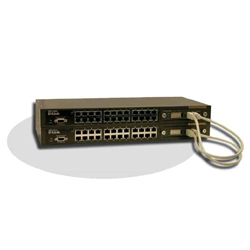
Product Description:
24-Port 10/100 Stackable Switch with Gigabit Option
The DES-3226S is a Stackable 10/100Mbps Layer 2 Switch designed for
departmental connection. It provides 24 10/100Mbps ports, 1 GBIC port
for server or fiber backbone connection, and scalable expansion through
switch stacking of up to 6 units. Advanced features such as port
trunking, VLANs and priority queues are also provided, allowing a
department to effectively deploy a bottleneck-free switching network
for easy integration with a larger enterprise or campus network.
24 10/100Mbps Ports for Workstation Connection
The switch provides 24 10/100Mbps ports supporting auto-sensing and
auto-negotiation of network speeds and full/half duplex. These ports
can connect to workstations and print servers, giving each a dedicated
bandwidth. All ports support auto MDI-II/MDI-X uplink, allowing you to
connect to workstations, servers, or other switches from any port
without the need to change your usual straight-through twisted-pair
cables.
Switch Stacking & GBIC Port
The switch provides an open slot for installation of a DES-332GS stack
module, which is equipped with a stacking port and a GBIC port. The
stacking port is for switch stacking. The GBIC port provides for
flexible deployment of multi-mode or extended cable-length single-mode
fiber. At 2000Mbps full duplex, this port gives you Gigabit server
connection or attachment to a fiber backbone.
Scalable Expansion
Up to 6 DES-3226S can be stacked together. You can add units to reach
maximum 144 10/100Mbps ports and 6 GBIC ports per stack. The switches
are stacked together through high-speed stack cables that provide
gigabit per second backplane, allowing the entire stack to perform as a
single entity.
Flow Control to Prevent Packet Loss
The switch supports standard IEEE 802.3x Flow Control. Working in
conjunction with buffer overrun auto-detection, this full-duplex data
transfer mode provides protection against possible data loss for 802.3x
supported servers directly connected to the switch.
Port Trunks for Aggregated Bandwidths
With low cost per port, port trunking provides an easy and economical
alternative solution for server connection to attain Gigabit bandwidth.
Up to 8 10/100Mbps ports or 6 Gigabit ports can be combined together to
create a multi-link load-sharing aggregated bandwidth to a server.
Trunked ports can span multiple units of the stack for fail-safe
connectivity to mission-critical servers and the network center. Up to
6 multi-link trunks can be configured for a stack.
VLANs for Enhanced Security & Performance
VLANs improve security and bandwidth utilization by limiting the
broadcast domains and confining intra-group traffic within their
segments. To segment up the network, workstations supporting IEEE
802.1Q VLAN Tagging connected to the switch can be grouped into
different Virtual LANs (VLANs). The switch also supports GVRP (GARP
VLAN Registration Protocol) for automatic VLAN configuration
distribution.
Priority Queues for QoS
The switch supports Layer 2 802.1p Priority Queue control. Each packet
going through the switch can be assigned a queue priority number (in
the priority bit). Packets with a higher priority number are allowed to
pass first. This function support allows you to attach IP telephony
devices or video servers to the switch to run delay-sensitive
applications like video conference and voice over the Internet.
Flexible Transmission Scheduling
The switch supports 2 methods of packet transmission scheduling: Strict
Round-Robin (SRR) and Weighted Round- Robin (WRR). You can select to
use SRR to strictly enforce your priority queues, or WRR to address
bandwidth limitations at peak time. WRR allows each queue to be
assigned a different percentage of the output port's bandwidth, so that
lower-priority queues are not denied access to buffer space and port
bandwidth.
IGMP Snooping for Broadcast Control
The switch listens to IGMP (Internet Group Management Protocol)
messages to build mapping table and associate forwarding filters. It
dynamically configures the switch ports to forward IP multicast traffic
only to those ports associated with multicast hosts.
Broadcast Storm Control
To limit too many broadcast/multicast flooding in the network,
broadcast/multicast storm control is configured to screen excessive
traffic. Packets are discarded if the respective count exceeds the
configured upper threshold in a given time interval. The possible range
of upper threshold is from 0 to 255k packets per second.
Port Mirroring
This function allows you to mirror adjacent ports for the purpose of
analyzing incoming and outgoing packets where packet patterns can be
studied.
Spanning Tree Protocol
For mission critical environments with multiple switches supporting
STP, you can configure the stack of switches with a redundant backup
bridge path, so transmission and reception of packets can be guaranteed
in event of any fail-over switch on the network.
SNMP & Web-based Management
The switch stack can be managed from within the LAN from an SNMP
management station, and via an Internet from any workstation.
Standard-based MIBs are built-in, allowing for monitoring and
management from third-party management platforms. Web-based management
program is built into the switch. RMON monitoring is through built-in
RMON MIBs.
Optional Ports (Stand-alone Configuration)
If you configure the DES-3226S as a stand-alone switch, you can install one the following modules in the open slot:
2-port Fast Ethernet multi-mode fiber module (100BASE-FX)
2-port Fast Ethernet single-mode Fiber module (100BASE-FX)
2-port Gigabit fiber module (1000BASE-SX)
2-port Gigabit fiber module (1000BASE-LX)
2-port Gigabit copper module (1000BASE-T)
GBIC module (2 ports)
Gigabit Over Copper Twisted-pair
The optional Gigabit copper ports provide an inexpensive alternative
solution to the fiber. Using your existing low-cost Cat. 5 twisted-pair
wires as the transmission media, these ports allow you to instantly
upgrade your servers to Gigabit capability without requiring you to
install new, expensive fiber cables. |